

Last Updated: October 26, 2026
Quick Summary
Buy artisan kitchen knives from specialty knife retailers, direct-from-maker sales, Japanese knife importers, or general kitchen retailers. Verify the maker's name, region, and steel type before paying, since a seller who can't answer those three questions isn't selling you a real handcrafted blade.
- Damascus steel is typically layered from 1095 and 15N20 high-carbon steels for a hard, long-lasting edge.
- Full-tang handles give a solid, balanced feel that partial tangs can't match.
- Sakai, Seki, and Kyoto are the three Japanese forging regions you'll see most often.
- New buyers should start with stainless or semi-stainless VG-10 or SG2 rather than pure carbon steel.
- Vet retailers on maker transparency, construction details, return policy, and warranty terms.
Why Artisan Kitchen Knives Are Worth the Search
Artisan kitchen knives are hand-forged blades made by individual craftspeople or small workshops, built for edge retention and balance rather than mass-market volume.
High Quality Steel Types for Blades: 420J2 vs 440C/D2
Most home cooks never make the leap. They buy a block set, use two of the six knives, and replace the whole thing when the handles loosen.
Most guides get it wrong: they treat artisan knives as decorative. They aren't. For the metallurgy behind that, read why hand forged steel stays sharp.
What to Look for When Buying Handcrafted Kitchen Knives
Start with steel and handle, then move to construction. Those three factors decide how a knife performs and how long it stays in your kitchen.
Blade Steel and Hardness: What the Numbers Tell You
Blade steel determines edge retention, rust resistance, and care demands. Damascus steel, typically layered from 1095 and 15N20 high-carbon steels, gives you a visible pattern and a hard, long-lasting edge.
High-carbon steel like 1095 holds a superb edge but will rust if you leave it wet. If you want to go deeper on grades, our guide to high quality steel types for blades breaks down 420J2 versus 440C and D2 side by side.
Handle Materials and Ergonomics That Fit Your Grip
Handle material is where comfort lives. Hardwood, rosewood, walnut, bone, and antler each change how the knife feels after an hour of prep. A full-tang handle, where the steel runs through the whole handle, gives a solid, balanced feel that partial tangs can't match.
Watch out: a beautiful handle that's too slick or too narrow will wear on your hand during long sessions. Our ergonomic knife handles guide covers grip and hand fatigue in more depth.
Where to Buy Japanese Knives and What to Expect
Japanese kitchen knives come from forging regions with centuries of tradition. Sakai, Seki, and Kyoto are the three you'll see most often: Sakai for thin, precise blades; Seki for production and consistency; Kyoto for traditional craftsmanship lineage.
Expect higher hardness, thinner grinds, and a steeper care curve. Many Japanese blades are carbon steel and demand drying and oiling after every use, but they reward that attention with edges that glide through fish and vegetables.
Where Japanese Knives Are Actually Sold
Japanese knives reach buyers through four main channels, and each has different trade-offs:
- Specialty knife retailers, Cutlery-only shops with staff who can speak to steel types and grinds. Best for maker attribution and care guidance, but inventory can be limited and restocks slow.
- Direct-from-maker and workshop sales, Some blacksmiths sell through their own sites or at craft fairs. Clearest provenance, but return policies are often minimal and shipping can be slow.
- Japanese knife importers and online specialists, Retailers importing directly from Japanese workshops, typically publishing maker names, region, and steel type. Ask whether they handle customs and what happens if a blade arrives damaged.
What to Verify Before You Buy
Authenticity is the catch. Provenance claims are easy to make and hard to verify. Ask sellers for the maker's name, the region, and the steel type. A retailer who can't answer those three questions isn't selling you a Japanese knife, they're selling you a story. The same skepticism applies to any handcrafted kitchen knives listing that leans on tradition without evidence.
A few concrete checks separate serious sellers from storytellers:
- Maker and workshop name, A real attribution names the smith or workshop, not just a region.
- Steel specification, Look for a specific steel (white steel, blue steel, VG-10, SG2) rather than a generic "high-carbon" label.
- Grind and geometry, Reputable sellers describe whether the blade is double-bevel or single-bevel, since that changes both use and care.
Price expectations vary widely by maker and region. Entry-level Japanese knives from established workshops typically start in the low hundreds of dollars, while knives from recognized master smiths can run well into four figures. The jump tracks the smith's reputation, the steel, and the finishing time, not blade size.
The Best Kitchen Knives for Home Cooks: Sets vs. Singles
Sets win on value and coordination; singles win on fit. For most home cooks, a curated three-piece set covers 90% of daily prep, and a single knife makes sense only when you know what's missing from your block.
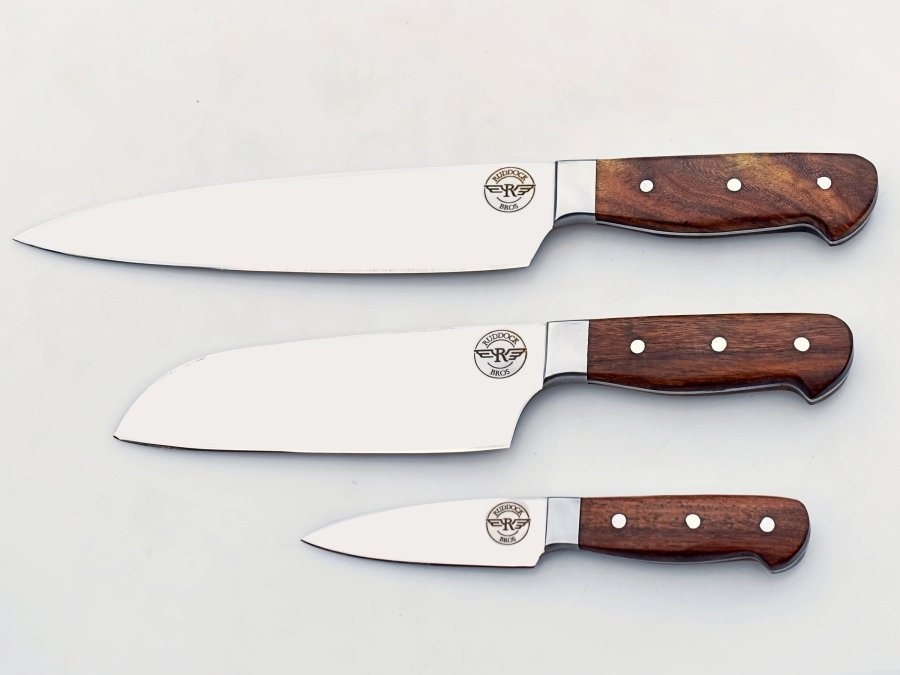
A chef's knife is the multipurpose workhorse, and a paring knife handles detail work. Our 3 Piece Chef Set in walnut and stainless at $99.97 pairs a chef's knife, a santoku-style knife, and a paring knife with full-tang walnut handles and a leather wrap.
Here's the short version: buy a set if you're starting fresh, buy a single if you're filling a gap. For a curated look at the top options, see our best kitchen knives for home cooks.
How to Vet a Knife Retailer for Authenticity and After-Sales Support
Vetting a retailer comes down to four checks: maker transparency, construction details, return policy, and warranty terms. A seller who passes all four is worth your money; one who dodges any is not.
Lone Star 3 Piece Chef Set - Damascus Steel →
Run this checklist before you buy anywhere:
- Can the retailer name the maker or workshop behind each blade?
- Does the listing state the steel type, layer count, and tang construction?
- Is there a written return window, and does it cover a knife that doesn't fit your hand?
Verifying Maker Attribution and Provenance
Provenance is the hardest claim to verify and the easiest to fake. "Hand-forged in the Japanese tradition" tells you nothing; a named workshop, region, and steel gives you something you can check.
Here's how to verify what you're told:
- Cross-check the maker name against the workshop's own site or published craft records. If the maker appears nowhere outside the retailer's listing, treat the attribution as unconfirmed.
- Look for a consistent paper trail, a maker card, certificate of origin, or workshop stamp on the blade. Not foolproof, but their absence is a warning sign.
- Ask about the steel by name. "High-carbon steel" is a category; "1095" or "VG-10" is a specification. A seller who can't name the steel likely doesn't know what's in the blade.
Shipping, Returns, and What After-Sales Support Should Include
After-sales is where most online shops fall apart. A knife is a long-term purchase, and you'll want sharpening advice, care guidance, and a real person to talk to. Ask how the seller handles a defect before you spend anything, if the answer is vague, walk away.
A retailer worth buying from should be able to answer these questions clearly:
- Shipping and handling, How is the blade packed, and is shipping insured? A knife shipped loose in a box is a knife that arrives chipped.
- Return window and condition, What's the window, and does it cover a knife that doesn't fit your hand or arrived with a defect? Get this in writing before you order.
- Warranty scope, Does the warranty cover manufacturing defects only, or does it extend to handle failure or edge issues under normal use?
Reputable sellers publish care instructions alongside the listing and answer sharpening questions by email before purchase. If a seller won't engage, that tells you what post-purchase support will look like.
Matching the Retailer to Your Experience Level
The right retailer depends on your experience level:
- Beginners should prioritize sellers with clear care instructions, generous return windows, and stainless or semi-stainless options. You're learning maintenance as much as cooking.
- Experienced cooks can buy from more specialized sellers, including direct-from-maker channels, because they can assess grind and steel for themselves and don't need hand-holding on care.
- Gift buyers should weight presentation, packaging, and return flexibility heavily, since the recipient may need to exchange for fit or preference.
Price and Value: What Your Money Actually Buys
Price in artisan cutlery tracks three things: steel quality, hand labor, and finishing. A hand-forged blade costs more than a stamped one because someone spent hours on it. That labor is the product.
Our own range shows how the tiers work. A single Blackwood Paring Knife in Damascus steel runs $34.95. A full Rosewood 5 Piece Damascus set runs $159.97 and includes a 9-inch carving knife, an 8-inch butcher knife, an 8-inch skinner, and two 5-inch chef knives in a leather roll. The Balboa 5 Piece set at $174.97 adds antler and hardwood handles with a complimentary maintenance kit.


Set |
Price |
Blades Included |
Handle |
Best For |
|---|---|---|---|---|
3 Piece Walnut & Stainless |
$99.97 |
Chef, santoku-style, paring |
Walnut, full tang |
First-time buyers |
Lone Star 3 Piece Damascus |
$99.95 |
Carving, paring, chef |
Hardwood and bone |
Gift buyers |
Lone Star 5 Piece Stainless |
$125.97 |
Carving, butcher, skinner, two chef |
Hardwood and bone |
Everyday kitchen use |
Rosewood 5 Piece Damascus |
$139.97 |
Carving, butcher, skinner, two chef |
Rosewood |
Cooks who entertain |
Regal 6 Piece Hammered Damascus |
$139.97 |
Six-piece set with sharpening steel |
Red, black, blue hardwood |
Display and daily use |
Balboa 5 Piece Damascus |
$174.97 |
Carving, butcher, skinner, two chef |
Antler and hardwood |
Heirloom collectors |
Above the entry tier, you're paying for pattern work, handle material, and finishing time. Whether that's worth it depends on how often you cook and whether you want a knife your kids will argue over later.
Choosing Your First Handcrafted Knife Set
Your first handcrafted set should match your actual cooking, not a fantasy version of it. Weekend cooks do fine with three pieces.
Our pick for a first set is the Lone Star 3 Piece Chef Set in Damascus steel at $99.95.

Lone Star 3 Piece Chef Set - Damascus Steel
And when you're ready to commit to a full Damascus set, the Lone Star 3 Piece Chef Set in Damascus steel is the concrete starting point we'd hand a friend.
Frequently Asked Questions
Where can I buy artisan kitchen knives?
You can buy artisan kitchen knives directly from maker-run online shops, specialty cutlery retailers, and at craft fairs or knife shows where you can handle the blade before buying. Buying direct from a family-run shop like Ruddock Bros., which has been in business since 1955, gives you a clear paper trail on provenance and a real person to call if something goes wrong. Always check whether the seller lists steel type, handle material, and a warranty before you commit.
How can I tell if a kitchen knife is actually handmade?
Look for inconsistencies that signal real handwork: slight variation in handle grain, a visible forge scale or hammer texture, and a Damascus pattern that shifts under light rather than repeating identically. Mass-produced knives stamped from a single sheet often have perfectly uniform patterns and no visible tang transition. Ask the seller directly how the blade is forged and whether each piece is inspected before shipping. A maker who stands behind the work will answer without hesitation.
Are Japanese kitchen knives worth buying for a home cook?
Japanese knives are worth it if you want a thin, hard blade that glides through vegetables and holds a fine edge, and you are willing to hand wash and dry it after every use. They typically run harder steel, which means better edge retention but more brittleness if you chop through bone or frozen food. For most home cooks, a Japanese-style santoku or chef's knife makes an excellent primary blade. Pair it with a sturdier Western-style knife for heavy tasks.
What type of kitchen knife is best for a home cook?
An 8-inch chef's knife handles about 80 percent of kitchen prep: chopping vegetables, mincing herbs, and slicing boneless meat. Add a paring knife for detail work and a serrated or carving knife for bread and roasts, and you have a functional kit. If you prefer a broader blade, a santoku-style knife works just as well for vegetables and slicing. Buy the best chef's knife you can afford, then expand from there.
Is it better to buy kitchen knives online or in person?
Online shopping gives you a wider selection, transparent pricing, and the ability to read reviews and compare specs side by side. In-person shopping lets you feel the balance and grip before you spend. A practical middle ground: buy online from a retailer with a clear return policy, then test the knife on a few meals within the return window. If the handle does not feel right in your hand, send it back.
The hardest part of buying artisan cutlery isn't finding a knife. It's finding a seller who stands behind it after the sale. At Ruddock Bros., we've been a family business since 1955, and we back every piece with a lifetime guarantee, free US shipping on orders over $150, and 1,400+ customer reviews from cooks who use these blades daily. Get started with Ruddock Bros. and put a knife on your board that you'll still be reaching for in twenty years.
