

Last Updated: September 30, 2026
What Most Home Cooks Get Wrong About Kitchen Knives
Most home cooks believe a bigger knife set means a better-equipped kitchen. The opposite is true: two or three well-made knives outperform a fifteen-piece block, because you learn how each blade handles and keep them sharp.
Why a $200 Knife Can Outperform a $400 Set
A single well-built knife beats a large mediocre set because steel quality and blade geometry matter more than quantity. One forged chef's knife with good edge retention outperforms a full block of stamped blades at less than half the cost.
Essential Kitchen Knife Set for Beginners
A beginner's knife collection needs three blades: an 8-inch chef's knife, a 3.5-inch paring knife, and a serrated bread knife. Everything else is clutter that dulls in a drawer.
The Three Knives You Actually Need
Chef's knife. Your workhorse, handling 80 percent of prep: chopping onions, slicing proteins, mincing garlic, breaking down vegetables. An 8-inch blade suits most hands; smaller hands prefer 6 inches.
Knife |
Blade Length |
Primary Tasks |
Frequency of Use |
|---|---|---|---|
Chef's knife |
8 inches |
Chopping, slicing, mincing |
Daily |
Paring knife |
3.5 inches |
Peeling, trimming, detail work |
Several times weekly |
Serrated bread knife |
9-10 inches |
Bread, tomatoes, cake |
Weekly |
Forged vs Stamped Knives for Home Use
Forged knives are shaped from a single heated bar of steel, producing a thicker bolster, a full tang, and better balance. Stamped knives are cut from sheet steel and ground into shape, making them lighter and cheaper. Both work; they suit different cooks.
When Stamped Makes More Sense
Stamped knives win in three situations: cooks with hand pain or arthritis prefer the lighter blade's reduced strain; small kitchens benefit from thinner blades; and cooks wanting a dedicated tomato or utility knife without a large investment get good value.
How to Maintain Kitchen Knife Sharpness
Maintaining kitchen knife sharpness comes down to two habits: honing before each use and sharpening two to three times a year. Honing realigns the edge; sharpening removes metal to create a new edge. Confusing the two ruins a good blade.
Honing vs Sharpening: What You Need and When
Honing uses a honing rod to straighten the microscopic bends that develop as you cut. Run the blade along the rod at roughly a 20-degree angle, five to eight strokes per side, before you cook.
Task |
Tool |
Frequency |
Time Required |
|---|---|---|---|
Honing |
Honing rod |
Before each use |
30 seconds |
Sharpening |
Whetstone |
Every 2-3 months |
15-20 minutes |
Full edge reset |
Whetstone, coarse grit |
Once a year |
30-40 minutes |
Ergonomics and Handle Fit: The Factor Most Buyers Ignore
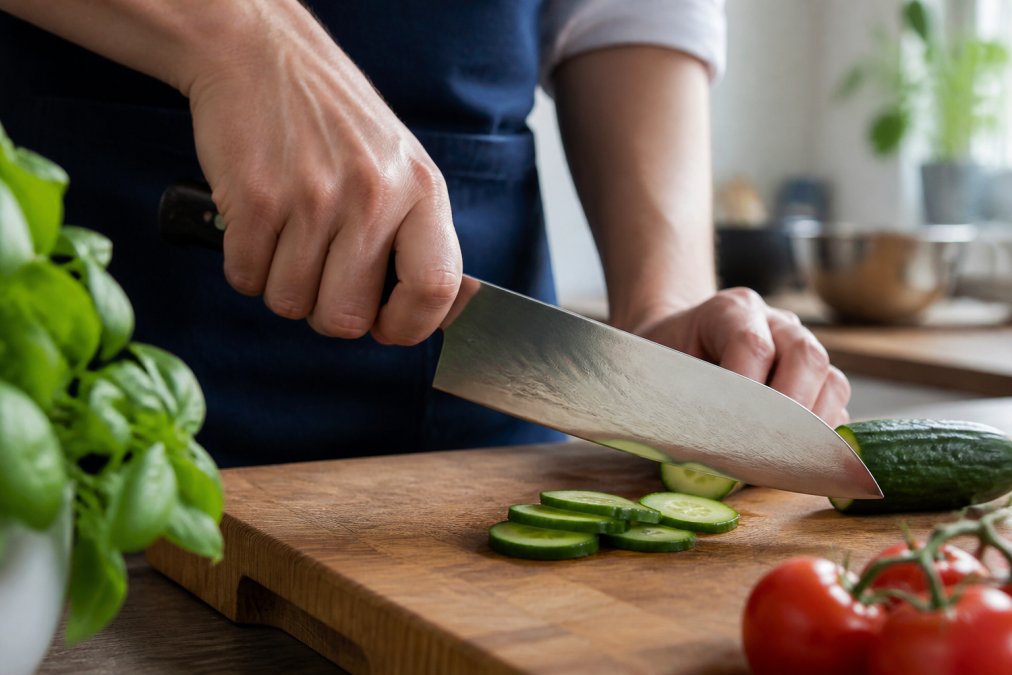
Handle fit decides whether you reach for a knife or avoid it. A blade with perfect steel and a handle that cramps your grip sits in the drawer while you grab something comfortable. It is the most overlooked factor in knife buying, and most guides just say "find what feels good" without giving you anything to measure.
Start With Hand Size, Not Blade Length
Measure your dominant hand from the crease at the base of your palm to the tip of your middle finger. That number, not your height or cooking style, best predicts which handle feels natural.
- Under 7 inches (smaller hands). Look for handles 4.0 to 4.25 inches long and 0.75 to 0.85 inches thick. A 6-inch chef's knife or 5-inch santoku usually balances better than an 8-inch blade, keeping the center of mass closer to your wrist. Slim, contoured synthetic handles beat thick, blocky wood.
- 7 to 8 inches (average hands). A 4.25 to 4.5 inch handle with an 8-inch chef's knife is the standard pairing for a reason: most production knives are designed around this range, so you have the widest selection.
- Over 8 inches (larger hands). You need a handle at least 4.5 inches long and a blade with a taller heel, roughly 2 inches or more, for knuckle clearance. A short handle forces your pinky off the end, where grip fatigue starts.
Knives for Arthritis, Reduced Grip Strength, and Hand Pain
This is the part most buying guides skip, and it matters for a large share of home cooks. The goal is not a "special" knife, but one that reduces the force you apply and the angle your wrist holds.
- Weight and balance. A lighter knife reduces the load on your hand, but too light forces you to press harder. The sweet spot for cooks with hand pain is a blade that balances at the bolster, so the knife does the work and your grip only steers.
- Handle diameter. A handle that is too thin is worse than one too thick, because it concentrates pressure on a smaller area of your palm. Look for a handle that fills your hand without forcing your fingers to curl tightly.
- Handle material and texture. Smooth, polished handles become slippery when your grip weakens or your hands are wet. A textured or rubberized synthetic handle, or matte-finish wood, gives more security with less squeezing.
- Blade height and rocker. A taller blade with a curved belly lets you rock through herbs and onions instead of pushing straight down, shifting effort from your grip to your forearm. A santoku's flatter profile requires more downward force, so cooks with hand pain often do better with a traditional chef's knife.
- Bolster and finger guard. A thicker bolster or pronounced finger guard gives your hand a physical stop, improving control when grip strength is limited, and keeps your fingers off the edge if your grip slips.
The Pinch Grip, and Why It Changes Everything
The pinch grip makes any knife feel more controlled. Grip the blade between thumb and forefinger just ahead of the handle, and wrap the remaining fingers around the handle. This puts your hand closer to the cutting edge, improving control and reducing wrist fatigue, and shortens the lever arm, so a knife that felt tip-heavy in a hammer grip often feels balanced.
Handle Materials: What Actually Matters
Handle material affects grip security as much as shape. Wood absorbs vibration and feels warm but needs oiling and should not be soaked. Synthetic handles resist moisture and clean easily, though polished versions feel slick when wet. Stabilized wood and laminated synthetics split the difference. Whichever you choose, fit in your hand matters more than the label.
Long-Term Cost of Ownership for Kitchen Knives
The cheapest knife is rarely the least expensive over five years. A real cost-of-ownership comparison includes the knife, sharpening, replacement cycle, and your time. Here is the math for a home cook who preps dinner four or five nights a week.
The Five-Year Math, Three Ways
These are typical patterns, not guarantees. Prices vary by brand and region, and a careful cook can stretch any of these numbers further.
Professional Sharpening vs. DIY: The Real Trade-Off
The decision is not just money. It is money plus time plus risk.
- Professional sharpening. A good sharpener uses a controlled angle and water-cooled equipment, so the blade stays cool and the bevel stays even. Cost is typically $5 to $20 per knife, with same-day to one-week turnaround. The risk is a bad sharpener who grinds too aggressively and shortens the blade's life.
- DIY with a whetstone. A $30 to $60 stone pays for itself after three or four professional sharpenings. The trade-off is a learning curve: most home cooks need several sessions to hold a consistent angle. Once learned, it is the cheapest long-term option for a knife you plan to keep for decades.
- DIY with a guided sharpener. A $40 to $100 guided system removes most angle guesswork and is faster than freehand stones, the best middle ground for repeatable results without a long learning curve.
- Pull-through carbide sharpeners. Cheap, but they remove too much metal per pass and leave a ragged edge. Over a few years they take a visible amount of steel off a good blade, the most expensive option in disguise.
What Actually Drives the Cost
Three variables decide whether a knife is cheap or expensive over time:
- Steel hardness and edge retention. Harder steel holds an edge longer, meaning fewer sharpening sessions and less metal removed per year. Softer steels sharpen easily but wear faster.
- Whether the knife can be serviced. A full tang, sensible blade geometry, and steel that tolerates repeated sharpening determine whether you replace or maintain it. Serrated knives are the clearest disposable design: they cannot be sharpened at home, so they get replaced when dull.
- Your time. A knife that holds an edge for weeks instead of days means fewer sharpening sessions, less prep frustration, and less chance you cook with a dull blade. For anyone cooking several times a week, that time adds up fast.
Buy fewer knives, buy better steel, and learn to hone. A three-knife collection you maintain will outperform a fifteen-piece block you neglect, and it will still be cutting well a decade from now.
Frequently Asked Questions
What three knives should every kitchen have?
A chef's knife (8-9in), a paring knife (3-4in), and a serrated bread knife cover 90% of home cooking tasks. The chef's knife handles most chopping, slicing, and dicing. The paring knife manages small precision work like peeling and trimming. The serrated bread knife cuts through crusty loaves and tomatoes without crushing them. Start with these three before adding a santoku, utility knife, or fillet knife to your collection.
What is the difference between forged and stamped kitchen knives?
Forged knives are shaped from a single heated steel bar, creating a thicker bolster, full tang, and heavier feel with better balance. Stamped knives are cut from a large sheet of steel, making them lighter and less expensive. Forged knives typically hold an edge longer and resist corrosion better due to denser steel. Stamped knives work well for beginners or specific tasks like bread slicing. Most home cooks benefit from at least one forged chef's knife.
How often should home cooks sharpen their knives?
Most home cooks need to sharpen their knives every 2-3 months with a whetstone, depending on use. Honing with a honing rod should happen every 1-2 weeks to realign the edge. If you cook daily, sharpen monthly. If you cook a few times a week, every 3-4 months works. Signs it's time: tomatoes squish instead of slice, or the blade slides off onion skin. Regular honing extends time between sharpening sessions.
How do I choose the right kitchen knife for my skill level?
Beginners should start with a forged chef's knife around 7-8 in with an ergonomic handle and full tang for balance. Avoid ultra-thin Japanese blades until your knife skills develop. Intermediate cooks can add a santoku for vegetables and a paring knife for detail work. Advanced home cooks may want a carbon steel blade for edge retention, though it requires more maintenance. Focus on how the knife feels in your hand over brand or price.
Choosing the right kitchen knives for a home kitchen is less about the size of your set and more about matching three good blades to your hands, your cooking style, and your willingness to maintain them. Ruddock Bros. builds hand-forged kitchen knives with full tangs, ergonomic handles, and a lifetime guarantee, backed by seven decades of serving customers and more than 1,400 customer reviews. Get started with Ruddock Bros. and equip your kitchen with cutlery built to last a lifetime.