

Last Updated: October 5, 2026
What Belongs in a Professional Pitmaster Knife Set
A professional pitmaster knife set essentials list starts with five blades: a boning knife, a slicing knife, a butcher knife, a chef knife, and a paring knife. Everything else is optional. The right pitmaster knife set covers trimming, breaking down, and serving without forcing you to improvise mid-cook. At Ruddock Bros., we've watched backyard cooks waste money on twelve-piece blocks where eight blades never leave the slot.
Below, we'll show you exactly which blades earn their place, how to choose blade lengths and steel, and why a dedicated meat slicer for brisket outperforms a carving knife on large cuts.
The Five Blades That Cover Every BBQ Task
A working barbecue kit needs one knife per job: boning, slicing, butchering, general prep, and detail work. Pitmasters who skip one end up forcing another blade to do work it wasn't shaped for, which dulls edges faster and produces ragged cuts. Five knives, maintained properly, handle everything from a whole packer brisket to a rack of ribs.
The next section breaks down what each one does, so you can match blade to task instead of guessing.
Essential BBQ Knives and What Each One Does
Essential BBQ knives fall into five categories, and each one solves a specific problem. Blade length, shape, and flexibility matter more than brand name. The table below gives you the baseline specs; the subsections that follow explain how to match each blade to the actual work on your board.
Knife |
Typical Blade Length |
Primary Task |
Best For |
|---|---|---|---|
Boning knife |
5-6 in |
Trimming, separating |
Silver skin, poultry, primal cuts |
Slicing knife |
10-12 in |
Clean, thin slices |
Brisket, roast, ham |
Butcher knife |
6-8 in |
Heavy breakdown |
Breaking whole cuts, splitting |
Chef knife |
8-10 in |
General prep |
Onions, herbs, vegetables |
Paring knife |
3-4 in |
Precision work |
Trimming fat caps, garnish |
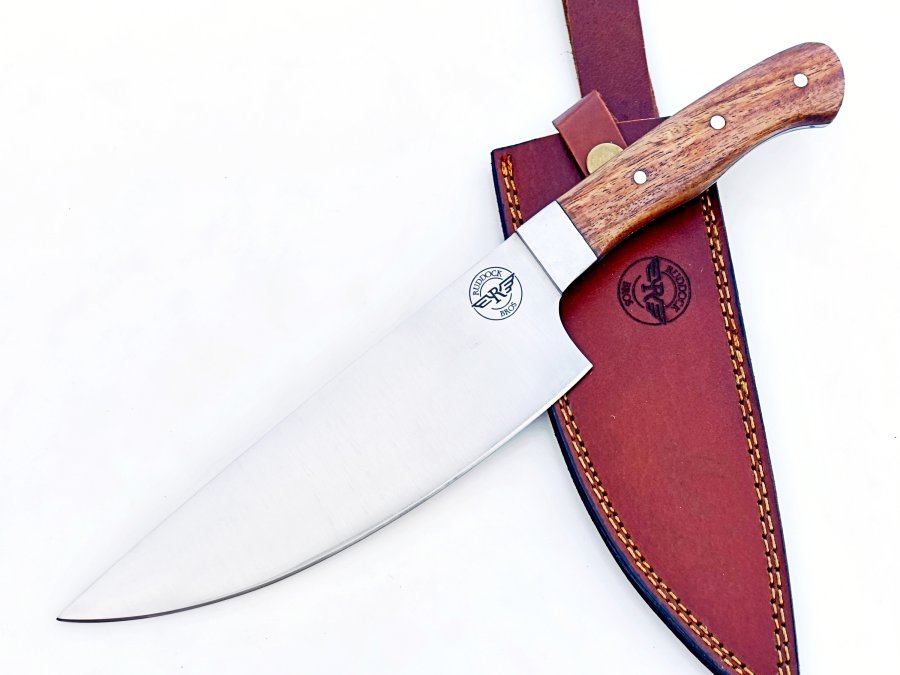
Boning Knife: Trimming and Breaking Down Cuts
A boning knife is the narrow, flexible blade that separates meat from bone without tearing it. Curved boning knives work best for poultry and pork shoulders, while straighter profiles suit beef primals. Flexibility matters here: a stiff blade fights you around joints, and a flexible one follows the bone.
This is the knife that saves you money. Buying whole cuts and breaking them down yourself beats paying a butcher's markup, and it starts with a boning knife you trust.
Slicing Knife: The Long Blade for Large Cuts
A slicing knife is the longest blade in the set, typically 10 to 12 inches, and it exists for one reason: to complete a slice in a single stroke. On a full packer brisket, a wide roast, or a whole ham, a short blade runs out of edge before it runs out of meat, forcing a second pass that tears the crust and squeezes out juice. The extra length lets you draw the blade through in one motion, which is what produces the clean, even slice face that holds together on the plate. If you cook brisket or large roasts more than a few times a year, this is the blade that earns its slot first.
Chef Knife, Butcher Knife, and Paring Knife Roles
The chef knife handles 80% of general prep, from onions to herbs. A butcher knife takes the heavy work: splitting chickens, breaking down whole loins, cutting through connective tissue. The paring knife does the fine detail, trimming fat caps and silver skin where a larger blade is clumsy.
Most home cooks already own a chef knife. The butcher and paring knives are the two people skip, and they're the two that make breakdown work faster.
Matching Blade to Task: A Quick Selection Guide
Instead of buying by piece count, buy by the jobs you actually do. Here's how the five blades map to common pitmaster tasks:
- Trimming a packer brisket: boning knife for silver skin and fat cap, then slicing knife for the final cuts.
- Separating ribs: boning knife follows the bone; a butcher knife handles the membrane and any stubborn connective tissue.
- Breaking down poultry: boning knife around the joints, butcher knife through the breastbone and backbone.
- Slicing cooked brisket or roast: slicing knife, full-length strokes, against the grain.
- Garnish and detail work: paring knife for herbs, fat caps, and small trims.
A common pattern is that cooks who skip the boning or slicing knife end up forcing a chef knife to do work it wasn't shaped for, which rolls the edge and shortens the time between sharpenings. Five knives, matched to task, cover everything from a whole packer to a rack of ribs.
Brisket Knife vs Carving Knife: Which Blade Belongs on the Board
A brisket knife is a long, thin, flexible slicer built for clean cuts through large smoked meats; a carving knife is shorter, stiffer, and designed for roasted poultry and smaller roasts. For a full packer brisket, the brisket knife wins.
The Ruddock Bros. Lone Star Brisket Knife runs 17 inches overall with a 12-inch blade, thin enough to glide through bark and smoke ring without compressing the meat. That length is the whole point.

That's the theory. Here's where most cooks go wrong: they blame their technique when the real problem is blade length.
Why a Meat Slicer for Brisket Beats a Carving Knife on Large Cuts
A meat slicer for brisket exists because large cuts demand a single, uninterrupted stroke.
The difference comes down to three measurable factors: blade length, edge geometry, and stroke count.
Blade length. A brisket slicer typically runs 10 to 12 inches of edge; a traditional carving knife runs 8 to 9.
Edge geometry. Slicers are ground thin behind the edge so they glide through bark and smoke ring without compressing the meat.
Stroke count. Competition turn-in boxes reward pencil-thin slices that hold together.
Lone Star 3 Piece Chef Set - Damascus Steel →
Three things a slicer does that a carving knife can't:
- Full-length strokes: a 12-inch blade crosses a wide flat in one motion, so the cut face stays smooth.
- Thin, consistent slices: competition turn-in boxes reward pencil-thin slices that hold together. Short blades produce thick, torn edges.
- Less compression: a thin, flexible blade glides instead of pushing, so juices stay in the meat rather than on the board.
If you cook brisket more than twice a year, a dedicated slicer is the single best upgrade you can make.
How to Slice Brisket Evenly Every Time
Slicing brisket evenly comes down to three variables: blade length, slice thickness, and stroke direction. Get those right and the rest follows.
- Rest the brisket 30 to 60 minutes. Cutting hot meat releases steam and dries the slice face.
- Separate the flat from the point. The two muscles run in different directions and must be sliced against their own grain.
- Use a long, thin slicer. A 12-inch blade completes each slice in one draw.
- Aim for pencil thickness. Roughly a quarter inch, consistent from end to end.
- Slice against the grain, always. With the grain gives you chewy, stringy pieces.
- Let the blade do the work. Draw the knife through; don't press down.
The Ruddock Bros. Lone Star Brisket Knife was built for exactly this: a 12-inch Damascus blade, 225+ layers, and a full steel tang that keeps the stroke steady through a wide flat.

Blade Length, Steel, and Edge Geometry: Measurable Selection Criteria
Blade length, steel type, and edge geometry are the three measurable specs that decide how a knife performs, and they matter more than handle color or marketing copy. Measure them before you buy.
Blade length should match your largest cut. A 12-inch slicer handles a full packer; a 5 to 6 inch boning knife handles trim work.
Steel type splits into two practical camps. High-carbon steels like 1095 take a keener edge and sharpen easily, but they rust without care.
Edge geometry is the shape of the grind behind the edge. Thinner geometry slices cleanly but chips under heavy work; thicker geometry survives abuse but drags through meat. Match geometry to task.
Care, Sanitation, and Safe Handling for Pitmaster Knives
Knife care comes down to four habits: hand wash, dry immediately, oil high-carbon steel, and store blades so edges never touch. Dishwashers ruin knives.
Sanitation matters as much as sharpness when you're breaking down raw meat. Wash with hot soapy water between proteins, especially after poultry. A secure grip prevents the most common pitmaster injury: a hand sliding forward onto a wet blade.
For storage, a leather sheath or a knife block keeps edges protected and fingers safe.
We stand behind every blade we sell. Ruddock Bros. has been a family business since 1955, and our lifetime guarantee exists because we stand behind our products, because we can!
Choosing the right blades for your barbecue setup comes down to matching knife to task, and that's harder than it sounds when every set claims to cover everything. At Ruddock Bros., we build handcrafted cutlery for cooks who take their meat seriously, from a 12-inch Damascus brisket knife with a full steel tang to a three-piece chef set in a leather pouch.

Frequently Asked Questions
What knives should be in a professional pitmaster knife set?
A working pitmaster knife set covers five jobs: a boning knife for trimming and breaking down cuts, a long slicer or brisket knife for clean slices, a butcher knife for heavy work, a chef knife for general prep, and a paring knife for detail. Add a cleaver if you split chickens or cut through bone. A curated three-piece set like the Lone Star Chef Set covers carving, paring, and chef work in one pouch, and you can build from there as your barbecue grows.
Is a brisket knife better than a carving knife?
For brisket, yes. A brisket knife has a long, thin, flexible blade, often 12 inches, that lets you cut a whole packer in one smooth stroke without sawing. A carving knife is shorter and stiffer, which works fine for turkey or roast but struggles on a wide brisket flat. If you cook brisket often, a dedicated brisket knife gives you thinner, more even slices and less torn bark.
Why use a meat slicer for large cuts of meat?
A meat slicer for brisket is an important tool for those larger cuts of meat compared to a carving knife. On a large cut like a whole brisket or a roast, consistency matters for plating, portioning, and tenderness. A carving knife relies on your hand alone, which is fine for a small roast but hard to keep even across a 12-pound packer. For volume cooking, the meat slicer wins on repeatability.
How do you slice brisket evenly?
Rest the brisket at least 30 minutes, then separate the flat from the point. Slice the flat against the grain in pencil-thick cuts, using one long draw of the blade instead of sawing. Turn the point 90 degrees and slice it against its own grain. A sharp 12-inch brisket knife, a stable cutting board, and a steady, single-pass stroke are what keep slices even and bark intact.
What is the difference between a boning knife and a butcher knife?
A boning knife has a narrow, flexible blade, often curved, made to work around bones and silver skin when trimming. A butcher knife is heavier and wider, built for breaking down larger cuts and chopping through joints. Most pitmasters keep both. The boning knife handles detail work on ribs and poultry, while the butcher knife takes on bigger jobs like splitting a pork shoulder.
How do I keep high-carbon steel knives from rusting?
High-carbon steels like 1095 rust if left wet. Hand wash with soap and hot water, dry completely, then wipe the blade with a thin coat of food-safe oil before storing. Never put them in a dishwasher. A leather sheath or a dry knife block keeps them protected between cooks. Done consistently, a carbon steel blade holds its edge longer and sharpens more easily than softer stainless.