

Last Updated: September 30, 2026
The Centuries-Old Steel Forging Heritage of the Region
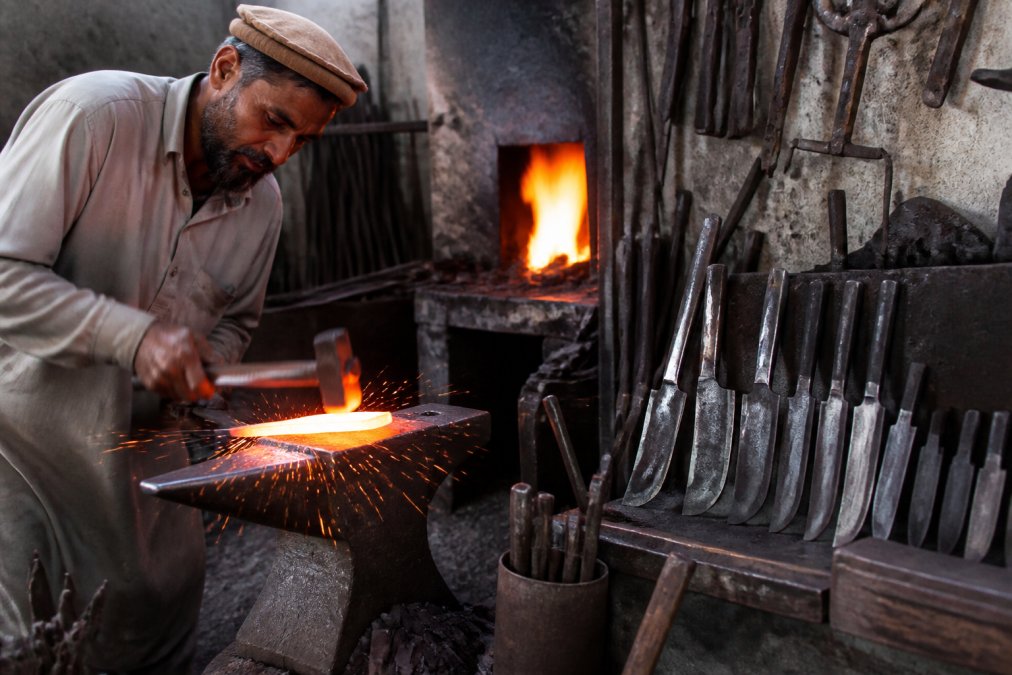
The story of why Pakistan produces premium steel blades begins long before modern factories existed, and it explains why the region's premium steel blades are trusted today. Forging traditions in the region stretch back multiple centuries, with bladesmiths passing techniques from father to son across generations. At Ruddock Bros., we've built on that inheritance.
That history matters because it explains the skill base. The hands that grind, temper, and finish blades today learned from lineages, not textbooks.
From Ancient Bladesmithing to Industrial Cutlery
The earliest forges in the region served farmers, hunters, and soldiers. Smiths worked with charcoal fires and hand hammers, judging temperature by color alone. Heat treatment was instinct, not instrumentation.
Industrialization changed the scale, not the fundamentals. By the mid-twentieth century, workshops began adopting powered grinding wheels and controlled furnaces. The forging process stayed manual at its core.
What most guides miss is how recently the region's reputation shifted. The turning point came when the country became a source for medical equipment, a sector that demands tolerances far tighter than cutlery ever did.
High Carbon Steel Knife Benefits in Premium Blade Production
The high carbon steel knife benefits are straightforward: better edge retention, higher achievable hardness, and a blade that responds well to sharpening. These are the properties that separate a working knife from a decorative one.
High-carbon steel typically holds more carbon than economy-grade alternatives, which allows it to reach higher Rockwell hardness after heat treatment. That hardness translates directly into edge retention during long trimming or deboning sessions.
The trade-off is corrosion resistance. Carbon steel demands care, and buyers who ignore that end up with pitting and discoloration.
Edge Retention and Hardness: What High Carbon Steel Delivers
Edge retention is the measure of how long a blade keeps a working edge under repeated use. A well-heat-treated high-carbon blade can go hours of fine deboning work between sharpenings, which is exactly what professional pitmasters and butchers need.
Hardness and toughness pull against each other. Push hardness too high and the edge chips; leave it too soft and it rolls. Tempering is the step that balances the two, and it's where inexperienced manufacturers cut corners.
How Medical Grade Steel Manufacturing Standards Reshaped Blade Quality
Medical grade steel manufacturing standards changed the region's cutlery sector more than any single technology. When local factories began producing surgical instruments and equipment for export, they had to meet documentation, traceability, and inspection requirements that cutlery makers had never faced.
The clearest example is ISO 13485, the quality management standard for medical devices. It is not a product test; it is a system requirement. A shop certified to it must control design, purchasing, production, and corrective action under one documented framework, and it must be able to show an auditor the records.
That pressure raised the floor for everyone.
Material Sourcing: High-Carbon vs. Economy-Grade Steel
Material sourcing decides the ceiling on any blade. High-carbon steel and economy-grade steel can look identical after polishing, but they behave nothing alike after a month of use.
The imported steel supply chain complicates things further, and it is the part most guides skip. Many regional workshops import alloy stock from established overseas mills, then forge and finish locally. What matters is whether the manufacturer can tell you which alloy it used.
The logistics are more ordinary than the marketing suggests. A workshop orders mill stock in flat bar or round bar, and the shipment arrives with a mill test certificate that states the heat number and chemistry. The shop logs that certificate, cuts the bar to length, and forges or stock-removes from there. The imported origin is not the quality claim. The traceable certificate is.
Rosewood Chef Knife Set - Damascus →
Grade |
Typical Carbon Content |
Edge Retention |
Corrosion Resistance |
Best For |
|---|---|---|---|---|
High-carbon steel |
Higher carbon, responsive to hardening |
Strong, holds an edge |
Lower, requires drying and oiling |
Chefs, pitmasters, hunters |
Economy-grade steel |
Lower carbon, softer |
Moderate, needs frequent honing |
Higher, more forgiving |
Casual kitchen use |
Clad/laminated |
Carbon core with softer layers |
Strong at the edge |
Improved by outer layers |
Collectors, display pieces |
A common mistake is assuming a shiny finish indicates quality. Finish is cosmetic. Alloy composition and heat treatment decide performance, and those are invisible to the eye.
The Role of Manual Craftsmanship in Blade Forging
Manual craftsmanship in blade forging is not nostalgia. It's a quality control method. A smith working by hand adjusts hammer force and timing in response to how the steel moves.
Hand forging also shapes blade geometry in ways that matter for cutting.
The thing nobody tells you about hand-forged blades is that slight variation is a feature.
Damascus Steel Manufacturing Techniques and Pattern Development
Damascus steel manufacturing starts with layering. Smiths stack alternating sheets of high- and lower-carbon steel, forge-weld them into a billet, then fold and re-weld repeatedly. Each fold multiplies the layer count.
Pattern development comes from how the billet is manipulated afterward. Cutting, stacking, and twisting the billet before final shaping produces the swirls, ladders, and raindrop patterns collectors recognize.
The pattern is not painted or etched on. It emerges because the different alloys respond differently to acid etching, revealing the layered structure beneath the surface.
Quality Control Challenges in Mass Production vs. Handcrafted Blades
Mass production and handcrafted blades fail in different ways.
Distinguishing handmade from factory-cloned blades comes down to details. Look at the plunge line where the bevel meets the flat, the symmetry of the grind, and whether the tang construction is full or partial.
Conclusion
Choosing a premium steel blade means reading past the finish and asking about alloy, heat treatment, and origin.
Ruddock Bros. has been building customer loyalty since 1955, and now building more with every blade we sell being hand crafted. We pride ourselves on using high quality steel, backed by our lifetime guarantee and free US shipping on orders over $150. Our customers keep coming back for the balance, the handle ergonomics, and the heirloom-grade durability that comes from seven decades of building quality relationships.
Get started with Ruddock Bros. and put a blade in your kitchen that will last a lifetime.
Frequently Asked Questions
Does Pakistan make quality knives?
Pakistan has a centuries-old bladesmithing tradition, and its cutlery industry has advanced significantly. The country's emergence as a source for medical equipment forced manufacturers to adopt stricter quality assurance and metallurgical testing protocols. Today, premium steel blades from the region are hand-forged using high-carbon steel, undergo controlled heat treatment, and meet standards comparable to those in established cutlery hubs. The key is distinguishing handcrafted blades from economy-grade mass-produced alternatives.
What are the benefits of high carbon steel for kitchen knives?
High carbon steel knife benefits include superior edge retention, easier sharpening, and greater hardness compared to economy-grade stainless. High-carbon blades typically achieve a Rockwell hardness of 58-62 HRC, which means they hold a sharp edge through hours of deboning and trimming. The trade-off is that high-carbon steel requires more maintenance to prevent corrosion, so drying the blade after use and applying a thin coat of oil is essential.
How has medical grade steel manufacturing standards influenced blade production?
When the region became a supplier for surgical instruments and medical equipment, manufacturers had to meet rigorous standards for alloy composition, heat treatment, and surface finishing. These medical grade steel manufacturing standards, including controlled tempering and strict quality assurance, carried over into cutlery production. The result is that premium handcrafted blades now benefit from the same metallurgical discipline once reserved for surgical tools.
How do I know a handcrafted blade is not just mass-produced with a premium label?
Look for evidence of manual craftsmanship. Ask about the forging process and heat treatment. A lifetime guarantee and transparent material sourcing are also strong indicators.