

Last Updated: October 7, 2026
Quick Comparison: 7 Heirloom Kitchen Knife Sets Worth Passing Down
"Best heirloom kitchen knife sets 2026" promises more than most cutlery can deliver. At Ruddock Bros., we've spent years selling knives, and we'll be honest: heirloom is mostly great marketing for "not disposable like the big box store junk." A knife built to last a decade is real.
Here's the short version before the detail:
Set |
Pieces |
Steel |
Handle |
Price |
|---|---|---|---|---|
Lone Star 3 Piece Chef Set |
3 |
Damascus |
Hardwood and bone |
$99.95 |
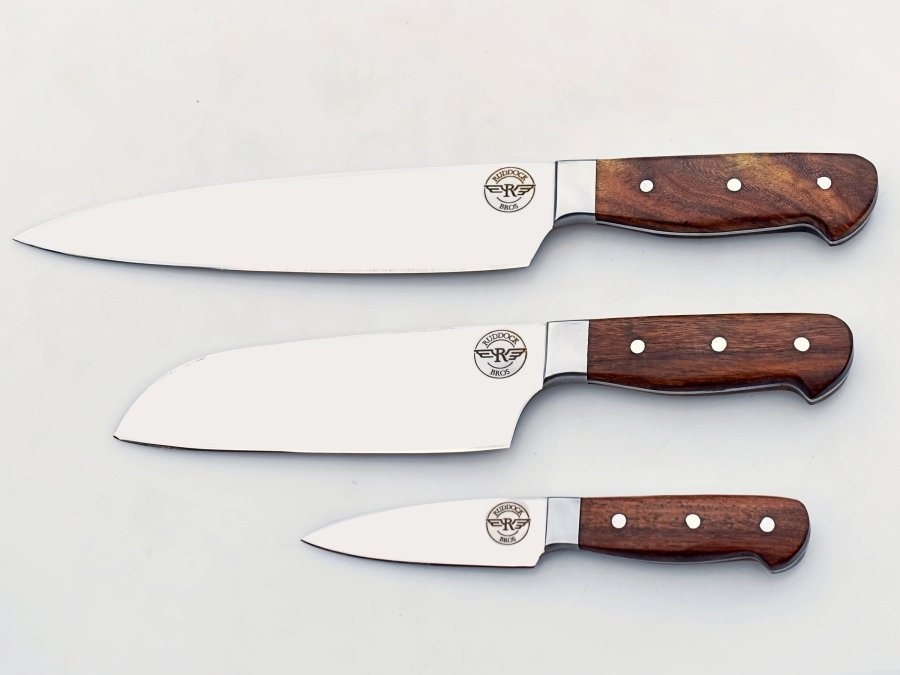
Walnut 3 Piece Chef Set |
3 |
Polished Stainless |
Walnut |
$99.95 |
Bone and Wood Chef Set |
5 |
Polished Stainless |
Natural bone and hardwood |
$179.95 |
Onyx 5 Piece Chef Set |
5 |
Polished stainless |
Black finish |
$189.95 |
Rosewood 5 Piece Chef Set |
5 |
Damascus |
Hardwood |
$199.95 |
Regal Chef Knife Set |
6 |
Hammered Damascus |
Red, black, blue hardwood |
$199.95 |
Custom Bone 5 Piece Chef Set |
5 |
Damascus etched stainless |
Bone |
$199.95 |
Americana 4 Piece Chef Set |
4 |
Stainless |
Bone and hardwood |
$199.95 |
Balboa 5 Piece Chef Set |
5 |
Damascus |
$249.95 |
|
Opal 5 Piece Chef Set |
5 |
Polished Stainless |
Resin Multicolored |
$189.95 |
What Makes a Kitchen Knife Heirloom Quality?
Heirloom quality means the knife can be sharpened, repaired, and rehandled rather than replaced. The blade steel holds an edge through years of use, the tang runs the full length of the handle, and the materials don't fail before the steel does.

The heirloom knives most of us inherited were German steel, decently hard, held an edge, and looked plain. They survived because someone maintained them.
Full Tang, Forged Blades, and the Hardware That Survives Decades
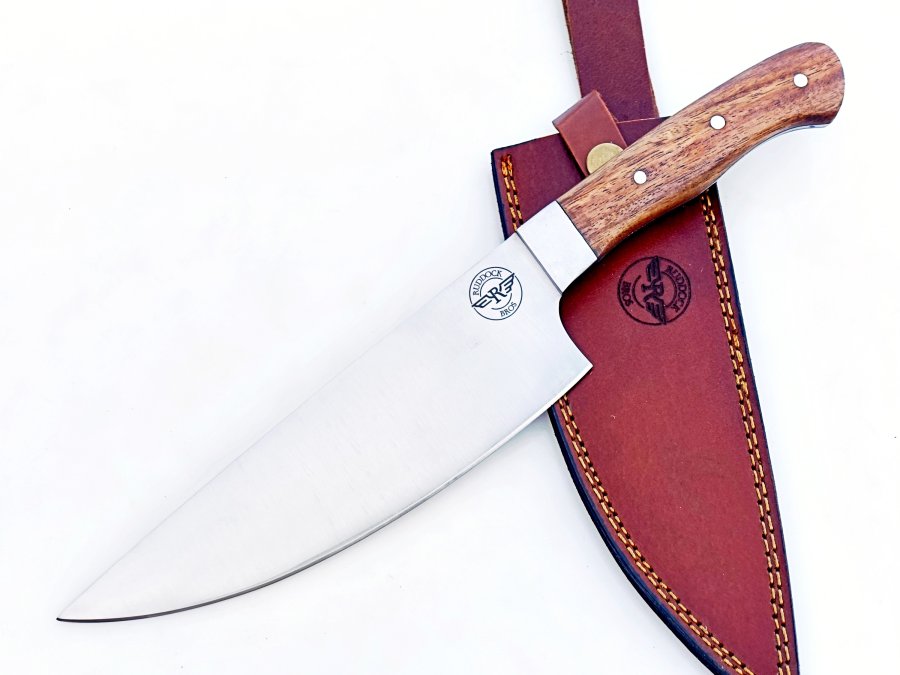
A full tang runs the steel from blade tip through the handle, so the knife won't snap at the bolster under hard use. Forged construction compresses the steel into shape rather than stamping it from a sheet.
What most guides miss: the handle fails first, not the blade. Resin, bone, and hardwood all outlast plastic, and all three can be sanded or replaced.
Knife Steel and Edge Retention: What Damascus and Stainless Actually Deliver
Damascus steel is a layered, pattern-welded steel that combines hard and softer layers, giving the blade both edge retention and toughness. Stainless steel resists corrosion with less day-to-day fuss.
Hardness is measured on the Rockwell scale. A blade that's too hard chips; too soft and it rolls. Damascus patterns in our sets are as much artistry as function, but the layered construction genuinely helps edge retention.
The 7 Best Heirloom Kitchen Knife Sets for 2026
Every set below is hand forged with full steel tang construction, comes with a leather storage case, and carries our lifetime guarantee. We buy from the foundry rather than running one ourselves, and we stand behind what we sell because we can.
Tux Chef Knife Set: The Entry Point at $159.95
The Tux is the set we recommend to anyone testing whether heirloom cutlery is for them. Six knives, blade sizes from 5" to 9", black and white resin handles, full steel tang, and a leather storage case.
At $159.95 it's the lowest-priced Damascus set we carry with a full knife count. The resin handle is the trade-off: durable and weather-resistant, but it won't develop the character that bone or hardwood does.
Rosewood and Regal: Two $199.95 Sets, Two Different Kitchens
Rosewood is the working set. Five knives with hardwood handles and full steel tang, blade sizes between 5" and 9", plus a leather roll with fitted slots.

Regal is the showpiece. Hammered steel, a regalia-inspired red, black, and blue wood tone, six pieces, and it ships with a sharpening steel alongside the leather case.
Balboa and the Custom Bone Set: Damascus With Character
Balboa pairs Damascus blades with genuine antler and hardwood handles. Five knives, $249.95, and a look no two sets share because the antler varies.
The Custom Bone 5 Piece is a one-off, built for a wedding that didn't happen: Damascus etched stainless blades, bone handles, and a magnetic knife block.
Bone and Wood, Americana, Onyx, Opal, Walnut 3 and Lone Star: Stainless and Starter Picks
Bone and Wood is the stainless workhorse: five knives, natural bone and hardwood handles, fire forged blades, $179.95.
Americana trims to four knives at $199.95 with the same bone and hardwood build.
Rosewood 5 Piece Chef Set - Damascus →
Onyx goes black: five knives, polished stainless, $189.95, with a magnetic knife block for counter display.
Lone Star is the starter set at $99.95: a carving, paring, and chef knife in a custom leather pouch.
Knife Set vs Individual Knives: Which Builds a Better Heirloom?
A set builds a better heirloom for most people because the pieces share steel, handle material, and maintenance needs. You keep one leather roll, one sharpening routine, and one coherent story to hand down. But "buy the set" is only right if the set matches how you cook, otherwise you are paying to maintain knives you never reach for.
When a set is the better long-term buy
- Your cooking is broad. If you roast, braise, break down poultry, trim vegetables, and slice bread in a normal week, a five- to seven-piece set covers that ground without gaps.
- You want one maintenance routine. Shared steel means one honing angle, one sharpening schedule, and one storage roll.
- You are buying to pass down. A matched set with a shared handle material and a single leather roll is easier to hand off intact than a drawer of mismatched knives.
When individual knives win
- Your cooking is narrow. If you break down game, trim brisket, or fillet fish and little else, three purpose-built knives beat seven generalists you never touch.
- You already own a chef knife you love. Adding a paring knife and a serrated bread knife to a knife you already trust is cheaper than replacing everything.
- You want to upgrade one piece at a time. Buying a single heirloom-grade chef knife now and adding a carving knife next year spreads the cost and lets you test the steel before committing to a full set.
The piece-by-piece test
Before you buy either way, list the knives you actually used in the last month. Most home cooks find they reach for four: a chef knife, a paring knife, a serrated knife, and a utility or carving knife.
Sets like Rosewood and Balboa already include a carving knife, butcher knife, skinner, and chef knives. If your list of used knives maps onto that lineup, the set is the better heirloom.
How to Maintain Kitchen Knives So They Outlast You
Hand wash and dry immediately. Never leave a knife soaking or run it through a dishwasher, because heat and detergent attack both the edge and the handle.
- Dry the blade fully before it goes back in the leather roll
- Hone lightly before each use to realign the edge
- Sharpen only when honing stops bringing the edge back
A common mistake is sharpening too aggressively and removing steel the knife can't spare. Hone often, sharpen rarely.
Repairability, Replacement Parts, and the Real Cost of a Knife Over 30 Years
Repairability is what separates an heirloom from a disposable. A knife with a full tang and pinned or riveted handle can be rehandled; a molded plastic handle cannot. Every set here uses full steel tang construction, which is the part that matters for repair. Here is what actually fails, what can be fixed, and what it costs you over decades.
What fails first, and in what order
- The edge. Every knife loses its edge with use. This is normal and reversible. Honing realigns the edge; sharpening removes a thin layer of steel to create a new one.
- The handle material. Resin, bone, and hardwood all outlast plastic, but they age differently. Hardwood can dry, crack, or shrink. Bone can chip at the pins. Resin is the most dimensionally stable but will not develop character.
- The pins and rivets. These loosen or corrode over decades of washing and drying. They are replaceable on a pinned handle.
- The tang. This is the last thing to fail, and on a full tang knife it rarely does.
What can actually be repaired
- Rehandling. A knife with exposed pins or rivets can have its scales removed and replaced. This is the single most important repairability feature, and it is why we specify full tang and pinned construction on every set.
- Reprofiling. A chipped or heavily worn edge can be ground back to a new profile, as long as too much steel has not already been removed.
- Pin and rivet replacement. Loose hardware can be drilled out and reset.
What cannot be repaired: a molded plastic handle bonded to a partial tang, a blade that has been sharpened past its usable steel, or a cracked blade. Those are replacement situations, not repair situations.
The 30-year ownership picture
Over thirty years, the math favors buying once. A set that costs more up front and gets honed and sharpened instead of replaced will outlast three rounds of cheap knives, and it will still be the knife your kids argue over. The recurring costs are modest and predictable:
- Honing. A few light passes before each use, using a honing steel. No cost beyond the steel itself.
- Sharpening. Professional sharpening every year or two for a home cook, or less often if you hone consistently. This is the main recurring expense.
- Handle oiling. A few times a year for hardwood and bone. A small bottle lasts years.
The pattern that kills cheap knives is not dullness, it is disposal. A knife that cannot be rehandled or sharpened back to life gets thrown out and replaced, and the replacement is usually the same quality. A repairable knife breaks the cycle because the only thing it ever needs is maintenance.
Conclusion: Buy Once, Hand It Down
The honest answer to whether heirloom knives are real: yes, with maintenance. They will age, they may lose their shine, and they will keep cutting. That's the whole promise.
We built our reputation over 70 years on relationships, trust, quality, and fair prices. Our sets carry a lifetime guarantee, free shipping on orders over $150, and a complimentary maintenance kit with every order.
Frequently Asked Questions
What makes a kitchen knife heirloom quality?
Three things decide it: a full tang running the length of the handle, a forged blade instead of a stamped one, and steel hard enough to hold an edge through years of honing. Handles matter too, since hardwood, bone, and antler can be refinished while cracked plastic cannot. A knife becomes an heirloom when it is still doing real work decades later, even if the pattern has faded and the handle has darkened with use.
Can a kitchen knife really last for decades?
Yes, if the blade is forged, the tang is full, and you maintain it. Damascus and high-carbon stainless blades hold an edge through repeated honing, and a full tang will not separate from the handle the way partial-tang budget knives do. The blades will age and may lose their original polish, but they keep cutting. Hand washing, drying immediately, and storing in a leather roll or on a magnetic block are what stretch a knife from years into decades.
Is a knife set better than buying individual kitchen knives?
A set usually wins on cost per knife and gives you a matched roll or block that protects every blade. Individual knives let you pick one perfect chef knife and skip the rest. For heirloom purposes, a set makes more sense because you are handing down a complete working collection, not one orphaned blade. A three-piece set like the Lone Star covers carving, paring, and chef work without paying for knives you will never touch.
How do you maintain kitchen knives so they last longer?
Hand wash and dry immediately, since sitting water is what causes rust and pits the edge. Hone before each heavy session to realign the edge, and sharpen only when honing stops bringing it back. Store blades in a leather roll, a magnetic block, or a fitted slot so edges never knock against each other. A drop of food-safe oil on hardwood handles once a season keeps them from drying and cracking.
Are expensive kitchen knife sets worth the money?
The math works when you divide by decades instead of years. A $199.95 Damascus set used for 25 years costs about $8 per year, and that assumes you never hand it to anyone else. Compare that to replacing a $60 big-box set every three or four years and the heirloom set is cheaper over its life. What you are paying for is forged steel, a full tang, and a handle that can be refinished rather than thrown away.