

Last Updated: November 3, 2026
What Hand Forged Quality Actually Means
Hand forged quality is the set of traits that show a blade was shaped by a person at an anvil rather than cut from a sheet of steel by a machine. Those traits show up as uneven hammer marks, a spine that tapers, and a handle built around the tang instead of molded over it.
At Ruddock Bros., we've been around metalcraft since 1955, and we buy from a foundry we trust rather than running one ourselves. That distinction matters when you're learning how to identify hand forged quality.
Here's the honest part most guides skip: hand forged quality isn't the same thing as handmade perfection. Each blade comes out slightly different. The shape is set by hand, so no two are identical. That variation is the signature, not the flaw.
Below, we'll walk you through the seven checks we use, plus the limits of what your eyes can tell you.
Hand Forged vs Stamped Kitchen Knives: The Core Differences
Stamped knives start as a flat sheet of steel. A machine punches the blade shape out, grinds an edge, and moves on. Hand forged knives start as a bar of steel that gets heated, hammered, and shaped over many rounds.
That difference changes everything downstream:
- Steel grain: Forging works the steel and can refine its internal structure. Stamping leaves the sheet's grain as it was.
- Weight and balance: A forged blade usually carries more mass near the spine and balances at the bolster. Stamped blades often feel light and tip-heavy.
- Tang: Forged knives typically run a full tang through the handle. Many stamped knives use a partial or hidden tang.
If you want the deeper cost breakdown, our guide on why premium kitchen knives cost more explains where the money actually goes.
How to Tell Hand Forged from Machine Forged
Machine forging is real forging, so it leaves marks too. The tell is repetition. Drop-forged blades come out of a die, so the pattern repeats exactly, blade after blade. Hand forging leaves marks that wander, vary in depth, and never match the next piece.
The 7-Point Inspection Checklist for Hand Forged Quality
Use this checklist on any forged piece before you commit. It works on chef knives, carving sets, and axes alike.
- Hammer marks: Present, uneven, and shallow near the edge.
- Spine taper: Thick at the handle, thinner toward the tip.
- Tang construction: Full tang visible at the handle scales.
- Handle fit: No gaps where wood meets steel.
- Edge geometry: A consistent bevel that follows the blade's curve.
- Surface finish: Forge scale or brushed texture, not a mirror coat hiding flaws.
- Bolster transition: Smooth, hand-blended, no sharp step.
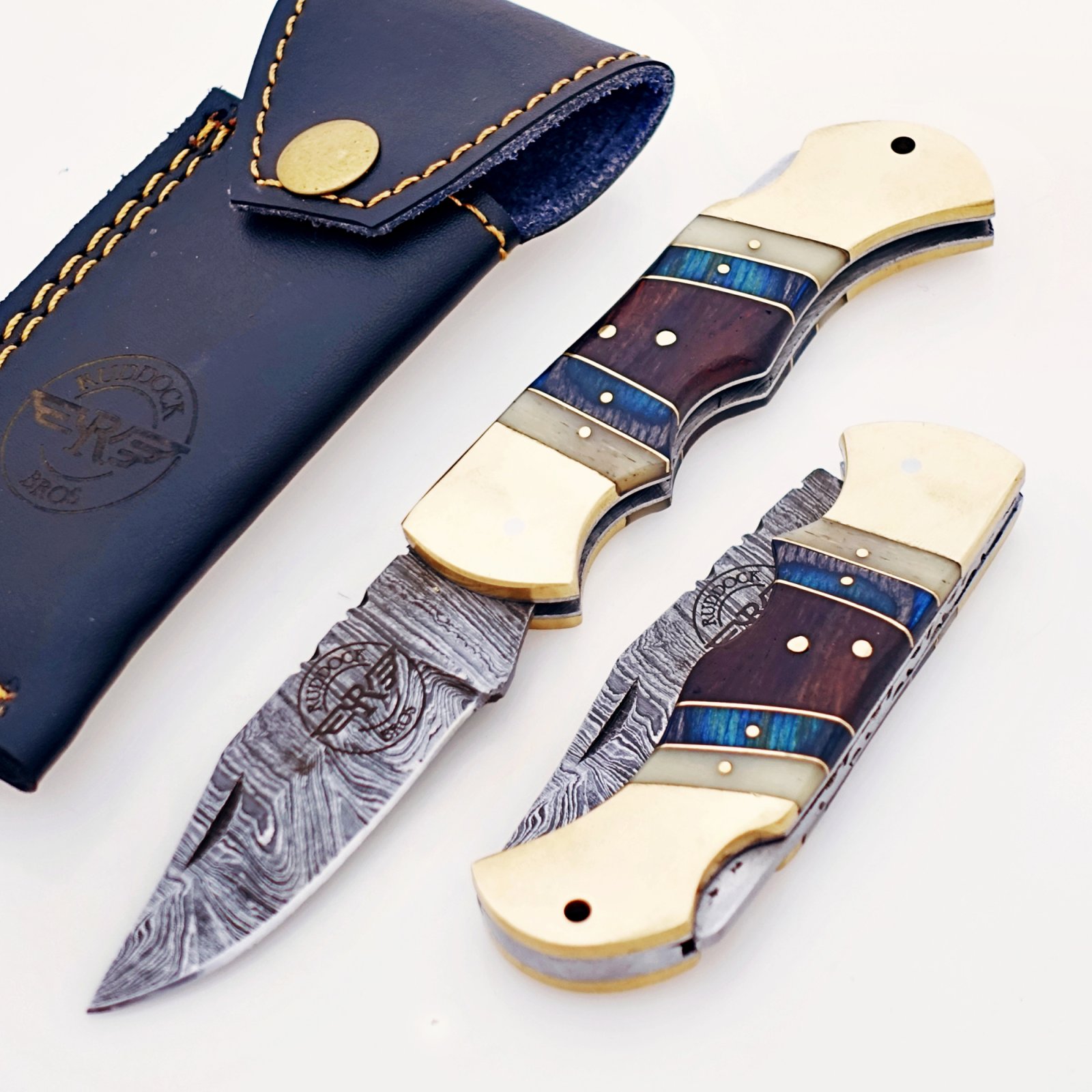
Damascus Steel Folding Knife for Everyday Carry
Checking Hammer Marks and Forging Traces
Hammer marks are the easiest signal to read and the easiest to fake.
If you want to see genuine hammer marks up close, our hammered Damascus knife set shows the real texture on a finished blade.

Regal Chef Knife Set - Hammered Damascus Steel
Reading the Spine, Tang, and Handle Fit
Check the tang next. A full tang should run the length of the handle and show at the butt. Then check handle fit. Natural materials like wood and horn move with humidity, so a tiny seasonal gap isn't a defect. A wide, uneven gap is.
Here are the seven checks we run on any forged piece before we commit.
Check |
What to look for |
|---|---|
Hammer marks |
Present, uneven, shallow near the edge |
Spine taper |
Thick at the handle, thinner toward the tip |
Tang construction |
Full tang visible at the handle scales |
Handle fit |
No gaps where wood meets steel |
Edge geometry |
Consistent bevel that follows the blade's curve |
Surface finish |
Forge scale or brushed texture, not a mirror coat |
Bolster transition |
Smooth, hand-blended, no sharp step |
Benefits of Hand Forged Cutlery That You Can Feel
The benefits of hand forged cutlery show up in your hand before they show up on paper. A forged blade carries more mass behind the edge, so it cuts with less effort.
Our article on why hand forged steel stays sharp covers the metallurgy without the textbook.
Then there's the feel. A hand-shaped handle fits a hand, not a mold. Marcus V. put it simply about his Damascus Santoku: "The balance is unlike anything else in my kitchen."
The Limits of Visual Identification
Your eyes can get you most of the way, but not all of it. Visual inspection tells you what a piece looks like, not how it was made. That gap is where most buying mistakes happen, so it's worth knowing exactly how the cues fail.
Lone Star Folding Knife - Damascus Steel →
How forging traces get faked or erased. A stamped blade can be ground, sandblasted, or tumbled to mimic a forged surface. A die can press a hammered texture into a blank in one stroke. An etcher can cut a pattern that reads as forge scale from arm's length. On the other side, a genuinely hand-forged piece can arrive with almost no visible marks because the maker filed, ground, or polished the blade smooth, a common finish on high-end kitchen knives and on decorative ironwork. Absence of hammer marks is not proof of machine work, and presence of them is not proof of hand work.
What finishing removes. Grinding and polishing are normal steps after forging. A maker who takes a blade to a fine finish may leave only faint ripples along the bevel or a subtle waviness in the spine. Look for those secondary traces, a spine that wanders by a few thousandths of an inch, a plunge line that isn't perfectly straight, a bevel that shifts slightly along the edge. Those irregularities are harder to fake than surface texture because they come from material removal by hand, not from a die.
Weigh evidence, don't score it. Treat every cue as one data point. A tapered spine plus a full tang plus a hand-fitted handle plus a named steel plus a maker who can describe the heat treatment is a strong case. Any single cue alone is weak. Two cues that could both be produced by a die are still weak together.
Watch out: buying on hammer marks alone is a common mistake. Texture is the cheapest thing to fake, and a mirror-polished hand-forged blade may show none of it.
Where visual inspection stops. It cannot confirm steel type, heat treatment, or hardness. It cannot tell you whether a tang is full under the scales. It cannot distinguish a well-made machine-forged blade from a poorly made hand-forged one. For those questions you need maker evidence, which the next section covers.
Material Testing and Maker Evidence Beyond the Eye
When looks aren't enough, ask the maker questions. A real forge can tell you the steel type, the heat treatment, and roughly how the blade was shaped. Vague answers are a red flag.
Ask these directly:
- What steel is this, and how was it heat treated?
- Is the tang full, partial, or hidden?
- Can you show me the forging stage, not just the finished product?
- What's the warranty, and what does it actually cover?
For steel, look for a named alloy. Our Damascus blades are listed as 1095/15N20 Damascus steel. A maker who names the steel is a maker who knows it.
Quality vs Handmade Provenance: Why Variation Is a Feature
Here's the tension worth sitting with. Handmade provenance and quality are related, but they aren't the same thing. A hand-forged blade can still be a poor blade if the heat treatment is wrong. A machine-made blade can be excellent.
So why pay for handmade? Because when the maker gets it right, you get a tool with character no die can produce. Each blade is slightly different, because each shape is handmade. We strive for perfect, but these are made by men, not machines.
That's the honest trade. You get art and variation, not stamped uniformity. If that trade appeals to you, our piece on what makes a knife heirloom quality lays out the seven traits that matter most.
Choosing a Hand Forged Blade You Can Trust
Trust comes down to three things: evidence, transparency, and a maker who stands behind the work. Use the checklist. Ask the questions. Then buy from someone who answers them without flinching.
At Ruddock Bros., we've built seventy years of relationships on exactly that. We buy from a foundry we trust, and we back our products with a Lifetime Guarantee. Take the Blackwood carving set at $149.95, a set with a steel tang and Damascus steel blades. Or start smaller with the Lone Star folding knife at $24.47 and see the difference for yourself.


When you're ready to buy with confidence, our guide on where to buy artisan kitchen knives walks you through the last step.
Frequently Asked Questions
What are the visual signs of a hand forged knife?
Look for irregular hammer marks along the blade face, a spine that tapers from bolster to tip, and a tang that runs the full length of the handle. Hand forged quality also shows in uneven surface finish and small variations between pieces, because each blade is shaped by hand. A perfectly uniform blade with no forging traces is usually stamped or machine ground. Check the handle fit too: gaps or proud pins suggest rushed assembly rather than careful craftsmanship.
How can you tell if a knife was made by a human or a machine?
Machines produce identical copies. Compare two knives from the same line: if the hammer pattern, handle grain, and spine taper match exactly, they were likely stamped or CNC-machined. A hand forged blade varies slightly from piece to piece, even within one maker's batch. Other cues include a distal taper that follows the grind line, a tang that shows forge scale under the handle, and a surface finish with subtle facets rather than a mirror-perfect plane.
Why is slight variation a sign of quality in handmade cutlery?
Hand forging means a person heats, hammers, and grinds each blade individually, so no two come out identical. That variation is evidence of hand shaping, not a defect. A maker who strives for perfect still works within the limits of human hands, and the small differences in hammer marks, handle grain, and blade profile are what make a piece one of a kind. Uniformity across every unit usually points to mass production instead.
How much is a hand forged knife worth?
Price reflects the labor, steel, and finishing time behind each blade. A hand forged knife costs more than a stamped one because a maker shapes it individually rather than stamping it from a sheet. At Ruddock Bros., pieces range from the Lone Star Folding Knife at $24.47 to the Blackwood Carving Set at $149.95, with the Regal Chef Knife Set at $139.97. Judge value by tang construction, steel type, and handle fit, not by price alone.
The gap between a mass-produced blade and a hand forged one is something you feel every time you cook. Ruddock Bros. has spent seventy years building relationships with makers we trust, and we stand behind every piece we sell. Our catalog pairs hand forged Damascus steel with full-tang construction and comfortable, secure handles, all covered by a lifetime guarantee. Get started with Ruddock Bros. and put a blade in your hand that you'll pass down.
